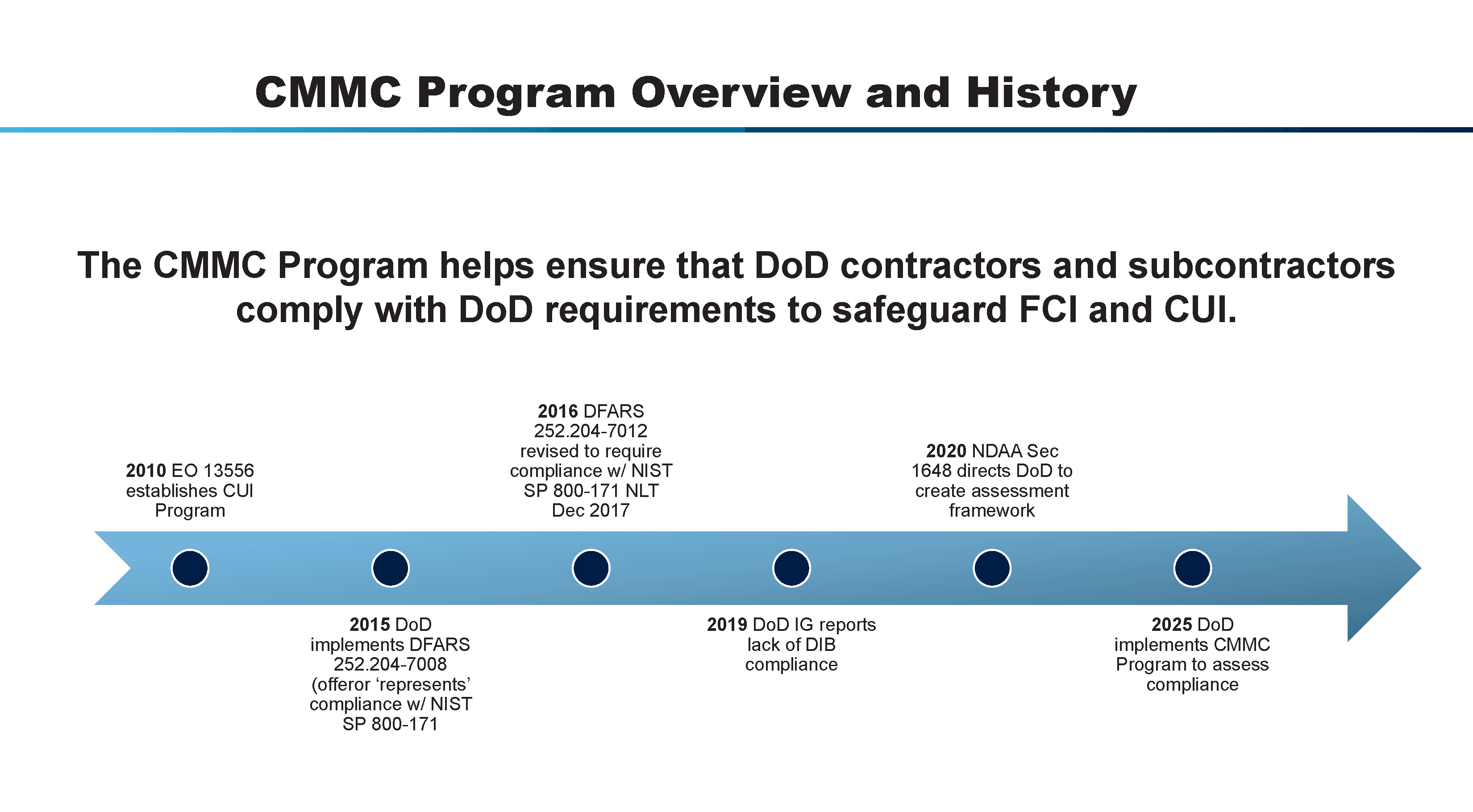
The CMMC will review and combine various cybersecurity standards and best practices and map these controls and processes across several maturity levels that range from basic cyber hygiene to advanced. Here’s what we know about the CMMC levels and their respective requirements:
The level of CMMC certification your organization needs depends on the type of DoD information you handle — either Federal Contract Information (FCI) or Controlled Unclassified Information (CUI) — and what your contract requires.
CMMC 2.0 is simplified into three levels, designed to protect sensitive information while reducing unnecessary burden on small and mid-sized defense contractors.
Level 1 — Basic Safeguarding of FCI
Designed for contractors who only handle FCI.
Requirements:
-
15 security requirements from FAR 52.204-21
-
Annual self-assessment performed by the contractor
-
Annual affirmation in SPRS
-
Results must be entered in SPRS
-
POA&Ms are not permitted
Validity: 1 year from assessment date
Level 2 — Protection of CUI
Designed for contractors handling CUI.
Requirements:
-
110 security requirements from NIST SP 800-171 Rev. 2
-
Assessment is either:
-
Annual affirmation in SPRS
-
Results entered into SPRS or eMASS depending on assessment type
-
POA&Ms permitted, must be closed within 180 days
-
Conditional CMMC Status allowed while POA&Ms are open
Validity: 3 years from assessment date
Level 3 — Advanced Protection of CUI
Applies to the highest-risk DoD programs impacted by advanced cyber threats.
Requirements:
-
All Level 2 requirements plus
-
24 additional security requirements from NIST SP 800-172
-
Assessed by DIBCAC every 3 years
-
Annual affirmation in SPRS
-
POA&Ms permitted, must be closed within 180 days
-
Requires Level 2 C3PAO Certification as a prerequisite
-
Conditional CMMC Status allowed while POA&Ms are open
Validity: 3 years from assessment date
Most small and medium-sized contractors will only need Level 1 or Level 2, while Level 3 will be limited to large prime contractors working on the most sensitive DoD programs.
The final program rule (32 CFR) for CMMC 2.0 became effective on December 16, 2024. However, the contractual requirement for new Department of Defense (DoD) solicitations and contracts begins November 10, 2025, when the 48 CFR/DFARS acquisition rule becomes enforceable.
How the rollout works
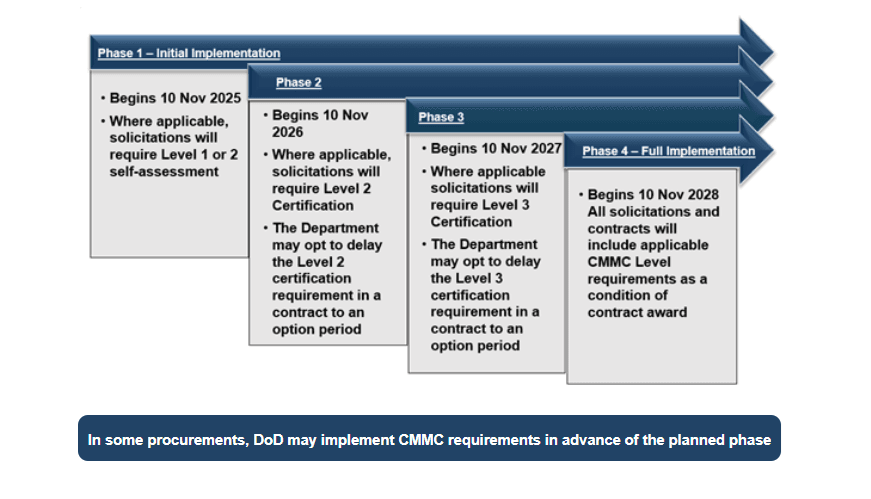
CMMC 2.0 will be implemented in a four-phase rollout for DoD contracts:
-
Phase 1 (Nov 10 2025): New solicitations may require CMMC Level 1 (self-assessment) or Level 2 (self-assessment) — and in some cases Level 2 third-party assessment.
-
Phase 2 (Nov 10 2026): Applicable solicitations/contracts begin requiring Level 2 third-party certification.
-
Phase 3 (Nov 10 2027): Broader Level 3 requirements apply and option periods/renewals incorporate CMMC clauses.
-
Phase 4 (Nov 10 2028): Full implementation — all applicable solicitations and contracts will include CMMC requirements as a condition of award.
What you should do now
If you handle Federal Contract Information (FCI) or Controlled Unclassified Information (CUI), start your readiness now: conduct a gap-assessment, identify your appropriate CMMC level, document your controls and self-assessment (or prepare for third-party when required), and ensure your SPRS (Supplier Performance Risk System) status is current. Missing readiness may mean ineligibility for future DoD contract awards.
Defense contractors are not compliant with CMMC until they coordinate with an accredited and independent third-party certification organization to perform a CMMC audit. It is in contractors best interest to partner with an agency like Simpatico Systems to help them prepare for a CMMC audit.